

Redesigned Emails Bolster Work-Study Applications
Organization : ideas42
Project Overview
Project Summary
Arizona State University freshmen students eligible for the Student Engagement and Employment Development Plan (SEED), a work-study program, received emails designed to emphasize the benefits of joining the program and eliminate hassles in the application process.
Impact
The redesigned emails increased the number of students applying for SEED jobs by 3 percentage points, from 9% to 12% of students.
Cost
The intervention cost $11 for each additional student sending at least one application to SEED or $2 per each additional application sent.
Challenge
Students often don’t take advantage of federal work-study opportunities. At Arizona State University (ASU), just 11% of the 2,046 eligible students applied for SEED jobs in the Fall 2014 semester. Consequently, only 20% of jobs were filled—leaving $684,000 in funds for eligible students unclaimed.
Design
A group of ASU freshmen eligible for SEED were sent emails about the program emphasizing the money available through work-study jobs, the access to mentors, and the potential for improved academics. These behaviorally informed emails also sought to reduce hassles in the application process by providing a sample ASU resume and a simple guide to listing references. The application deadline was clearly stated and students were offered a link to a scheduling tool that helped them plan a time to complete their application.
The other group of SEED-eligible freshmen received standard ASU emails about the program.
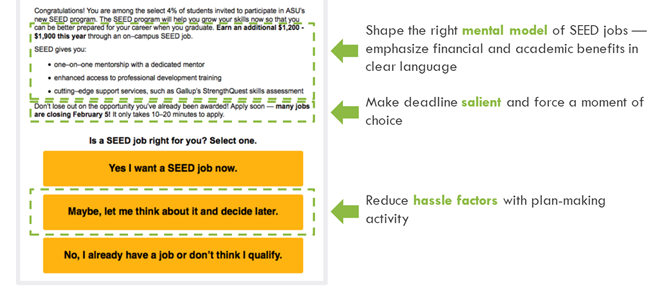
Redesigned email sent to eligible students
Impact
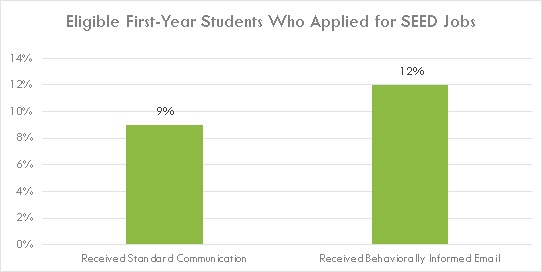
A randomized evaluation found that the redesigned emails increased the number of students applying for SEED jobs by 3 percentage points, from 9% to 12%. Additionally, there was a 56% increase in the number of applications submitted, from 304 to 475 applications. Newly hired students earned an average of $1,600 more over the course of one year, providing a steady stream of income for needs such as books, food, or supplies that students may not fully anticipate when calculating the cost of college.
Implementation Guidelines
Inspired to implement this design in your own work? Here are some things to think about before you get started:
- Are the behavioral drivers to the problem you are trying to solve similar to the ones described in the challenge section of this project?
- Is it feasible to adapt the design to address your problem?
- Could there be structural barriers at play that might keep the design from having the desired effect?
- Finally, we encourage you to make sure you monitor, test and take steps to iterate on designs often when either adapting them to a new context or scaling up to make sure they’re effective.

